
- Your cart is empty
- Continue Shopping
encoders
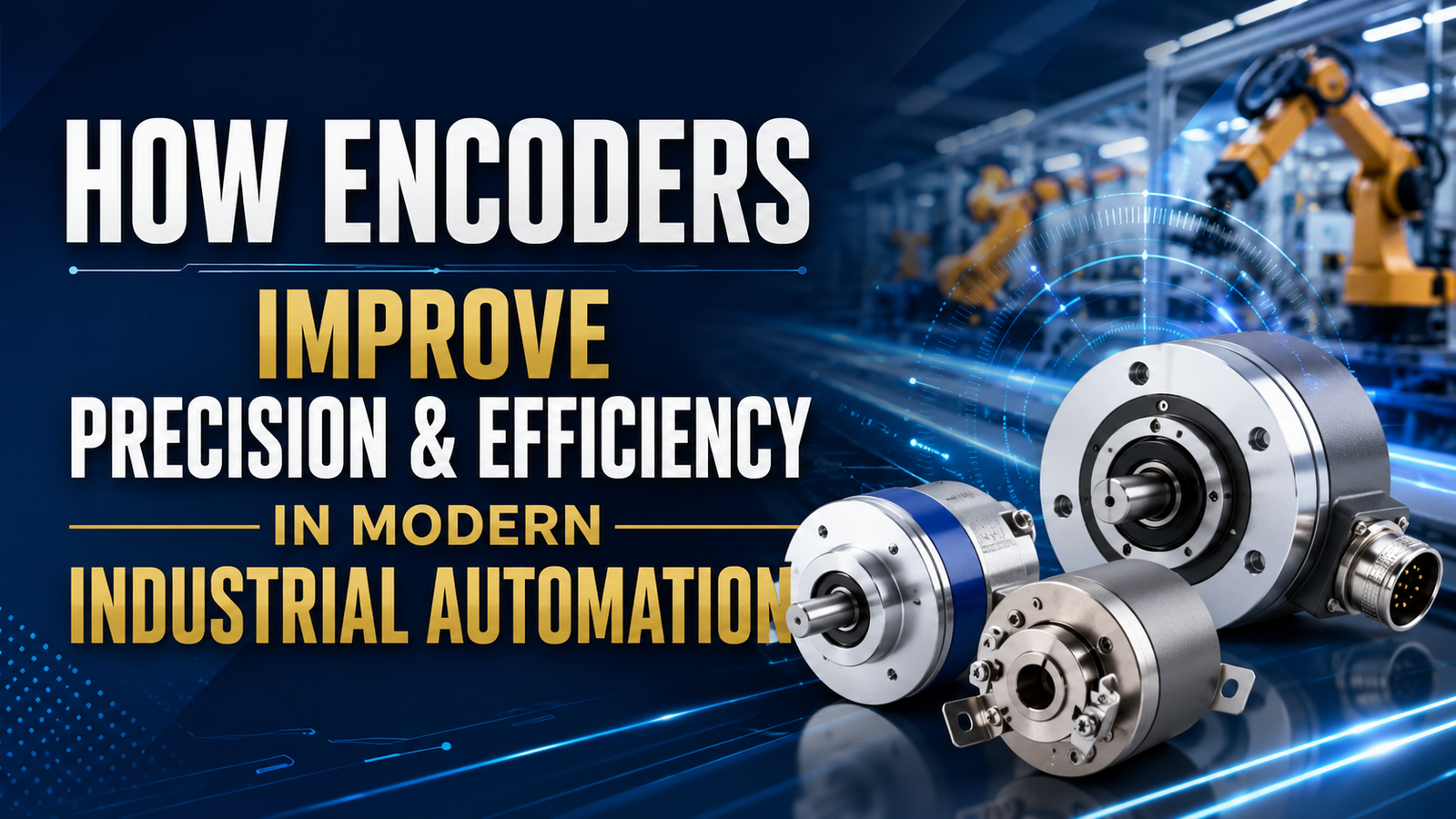
How Encoders Improve Precision and Efficiency in Modern Industrial Automation
-
By digiwebcore@gmail.com
- Posted on
- 0 comments
In today’s competitive manufacturing landscape, precision and efficiency are no longer optional—they are essential. From automotive assembly lines and CNC machining to packaging equipment and robotic systems, every industrial process relies on accurate motion control. One of the most critical components that make this possible is the industrial encoder.
Encoders provide real-time position and speed feedback, enabling machines to perform tasks with exceptional accuracy. Whether it’s maintaining precise motor positioning, synchronizing multiple machine axes, or ensuring consistent production quality, encoders have become the backbone of modern factory automation.
In this blog, we’ll explore how encoders work, the differences between rotary and linear encoders, their applications, and why they are indispensable for today’s automated industries.
What is an Encoder?
An encoder is an electromechanical sensing device that converts mechanical motion into electrical signals. These signals are transmitted to controllers such as PLCs, motion controllers, or servo drives, allowing machines to determine the exact position, speed, direction, or distance traveled.
Without encoder feedback, machines would operate with significantly lower precision, leading to production errors, increased waste, and reduced efficiency.
Encoders are commonly integrated into:
- Servo motors
- Stepper motor systems
- CNC machines
- Conveyor systems
- Robotics
- Packaging machinery
- Printing presses
- Textile machines
- Material handling equipment
How Does an Encoder Work?
Encoders continuously monitor movement and convert it into digital or analog signals.
The operating process typically involves:
- Detecting rotational or linear movement.
- Converting movement into electrical pulses or coded signals.
- Sending these signals to a controller.
- Allowing the controller to calculate:
- Position
- Speed
- Direction
- Distance traveled
The control system then adjusts motor performance in real time, ensuring highly accurate machine operation.
Types of Industrial Encoders
1. Rotary Encoders
Rotary encoders measure the rotational movement of shafts and motors.
They are widely used for:
- Servo motors
- Electric motors
- Conveyor rollers
- Gearboxes
- Machine tools
Advantages
- Accurate shaft positioning
- Speed monitoring
- Direction detection
- Compact installation
- High reliability
Common Applications
- CNC machining centers
- Packaging equipment
- Robotics
- Elevators
- Printing machines
- Material handling systems
2. Linear Encoders
Linear encoders measure movement along a straight path rather than rotational movement.
They provide direct position feedback without relying on mechanical transmission components.
Advantages
- Extremely high positioning accuracy
- Reduced cumulative mechanical errors
- Excellent repeatability
- Ideal for long travel distances
Common Applications
- CNC milling machines
- Coordinate Measuring Machines (CMM)
- Laser cutting systems
- Semiconductor manufacturing
- Precision assembly machines
- Medical equipment
Incremental vs Absolute Encoders
Industrial encoders are also categorized based on how they provide position information.
Incremental Encoders
Incremental encoders generate pulses as movement occurs.
They are ideal for measuring:
- Speed
- Direction
- Relative position
Benefits
- Cost-effective
- Simple installation
- High-speed performance
- Widely used in automation
Absolute Encoders
Absolute encoders assign a unique digital value to every shaft position.
Even after power loss, they retain the exact position information.
Benefits
- No homing required
- Faster machine startup
- High precision
- Improved safety
- Reliable position tracking
Why Encoders Are Essential in Industrial Automation
1. Superior Position Accuracy
Industrial processes often require positioning accuracy measured in microns.
Encoders continuously monitor movement, allowing machines to stop exactly where intended.
This precision is vital in:
- CNC machining
- PCB manufacturing
- Laser cutting
- Semiconductor production
2. Higher Production Speed
Real-time encoder feedback enables motion controllers to optimize acceleration, deceleration, and synchronization.
The result is:
- Faster production cycles
- Reduced idle time
- Improved machine utilization
3. Improved Product Quality
Consistent positioning directly impacts product quality.
Encoders help eliminate variations in:
- Cutting dimensions
- Filling quantities
- Printing alignment
- Assembly positioning
This reduces rejects and improves customer satisfaction.
4. Reduced Downtime
Encoder feedback helps detect:
- Motor slippage
- Position errors
- Mechanical wear
- Unexpected movement
Maintenance teams can identify issues early before they result in costly machine failures.
5. Better Energy Efficiency
Motors only consume the energy required to perform their tasks when motion control is optimized.
Accurate encoder feedback minimizes unnecessary corrections, reducing power consumption and improving overall system efficiency.
Industries That Depend on Encoders
Industrial encoders are used across a wide range of sectors, including:
Automotive Manufacturing
- Robotic welding
- Assembly lines
- Paint shops
- Material transfer systems
Food & Beverage
- Filling machines
- Packaging lines
- Labeling equipment
- Conveyor systems
Pharmaceutical
- Tablet manufacturing
- Bottle filling
- Inspection systems
- Sterile packaging
Textile Industry
- Fabric tension control
- Yarn winding
- Printing machines
- Cutting equipment
Packaging Industry
- Carton sealing
- Label placement
- Film feeding
- Product sorting
Metal Processing
- CNC machining
- Laser cutting
- Press brakes
- Grinding machines
Choosing the Right Encoder
Selecting the appropriate encoder depends on several factors:
- Required accuracy and resolution
- Operating speed
- Shaft size and mounting configuration
- Environmental conditions (dust, moisture, vibration)
- Output interface (Incremental, SSI, CANopen, EtherCAT, PROFINET, etc.)
- Temperature range
- Protection rating (IP65, IP67, IP69K)
- Power supply requirements
Working with an experienced automation solution provider helps ensure the right encoder is selected for your application, maximizing performance and long-term reliability.
The Future of Encoders in Smart Manufacturing
As Industry 4.0 and Industrial IoT continue to evolve, encoders are becoming smarter and more connected.
Modern encoder technologies now offer:
- Higher resolutions
- Faster communication protocols
- Real-time diagnostics
- Predictive maintenance capabilities
- Integration with Industrial Ethernet networks
- Enhanced reliability in harsh environments
These advancements enable manufacturers to build intelligent factories with improved productivity, reduced downtime, and greater operational visibility.
Conclusion
Encoders are a fundamental component of modern industrial automation, delivering the precise motion feedback required for accurate positioning, speed control, and synchronized machine operation. Whether using rotary encoders for shaft rotation or linear encoders for direct linear measurement, these devices help manufacturers improve precision, increase production speed, reduce waste, and maintain consistent product quality.
As factories continue to embrace automation and smart manufacturing technologies, investing in the right encoder solutions can significantly enhance operational efficiency and support long-term business growth.
If you’re looking for reliable industrial encoders, sensors, or complete factory automation solutions, partnering with an experienced automation provider can help you select the ideal products for your application and achieve optimal performance across your production processes.
