
- Your cart is empty
- Continue Shopping
factory automation
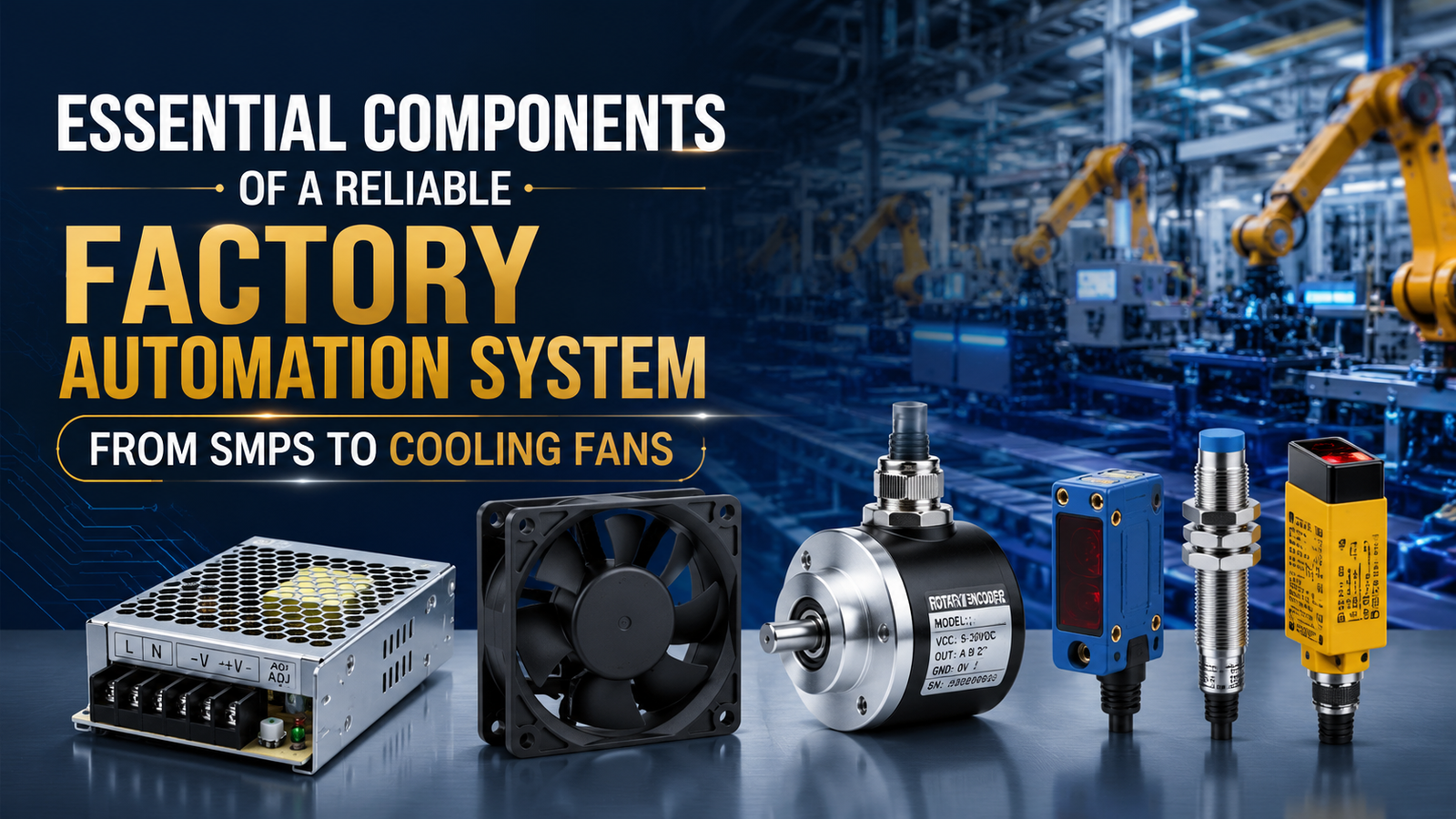
Essential Components of a Reliable Factory Automation System: From SMPS to Cooling Fans
-
By digiwebcore@gmail.com
- Posted on
- 0 comments
Automated systems help industries improve productivity, reduce human error, minimize downtime, and maintain consistent product quality. However, the performance of an automation system depends not only on advanced PLCs and software but also on the reliability of the components that support the entire system.
From SMPS (Switched Mode Power Supplies) and industrial cooling fans to encoders and industrial sensors, every component plays a crucial role in ensuring smooth and uninterrupted operations. Selecting high-quality automation components can significantly improve equipment efficiency while reducing maintenance costs over time.
1. SMPS – The Power Behind Automation
A Switched Mode Power Supply (SMPS) is one of the most essential components in any industrial automation setup. It converts incoming electrical power into a stable DC output required by PLCs, sensors, relays, controllers, and other automation devices.
An efficient SMPS offers several benefits:
- Stable and reliable power output
- High energy efficiency
- Compact design with low heat generation
- Protection against overload, short circuits, and voltage fluctuations
- Longer lifespan for connected equipment
A reliable power supply minimizes unexpected shutdowns and helps maintain continuous production, making it an indispensable part of every control panel.
2. Industrial Cooling Fans – Protecting Critical Equipment
Heat is one of the biggest threats to industrial electronics. Components such as PLCs, VFDs, power supplies, and control panels generate heat during operation. Without proper ventilation, excessive temperatures can reduce equipment performance and shorten component life.
Industrial cooling fans help maintain the optimal operating temperature by improving airflow inside electrical enclosures.
Their key advantages include:
- Prevent overheating
- Improve equipment reliability
- Extend component lifespan
- Reduce maintenance requirements
- Ensure uninterrupted machine operation
Choosing the right cooling fan based on airflow, voltage, size, and environmental conditions is essential for efficient thermal management.
3. Encoders – Delivering Accurate Motion Control
Encoders are widely used in factory automation for monitoring the position, speed, and direction of rotating equipment. They provide real-time feedback to control systems, allowing machines to operate with exceptional accuracy.
Industrial encoders are commonly found in:
- CNC machines
- Packaging equipment
- Conveyor systems
- Robotics
- Textile machinery
- Elevator and lift systems
Depending on the application, manufacturers can choose between incremental encoders for speed monitoring or absolute encoders for precise position tracking. Lift encoders are specifically designed to ensure smooth and accurate elevator movement, enhancing both safety and performance.
4. Industrial Sensors – The Eyes of Automation
Sensors are responsible for detecting physical changes and transmitting signals to automation systems. They help machines make decisions without human intervention, improving productivity and operational safety.
Common industrial sensors include:
- Photoelectric sensors
- Inductive proximity sensors
- Capacitive sensors
- Ultrasonic sensors
- Magnetic sensors
These sensors are widely used for object detection, counting, positioning, level monitoring, and quality inspection across manufacturing industries.
Reliable sensors contribute to:
- Faster production cycles
- Improved process accuracy
- Reduced manual intervention
- Enhanced workplace safety
- Better quality control
5. Why Quality Components Matter
Many industries focus on purchasing advanced automation systems while overlooking the importance of supporting components. Even a small failure in a power supply, encoder, sensor, or cooling fan can lead to machine downtime and production losses.
Using premium-quality automation components offers several long-term benefits:
- Reduced maintenance costs
- Improved machine efficiency
- Longer equipment life
- Increased production uptime
- Better operational safety
- Higher return on investment
Investing in trusted industrial components is often more cost-effective than dealing with frequent replacements and unexpected breakdowns.
Choosing the Right Automation Solution Provider
Selecting the right automation products is just as important as choosing the right supplier. An experienced factory automation solution provider understands industrial requirements and helps customers select products that match their applications.
When choosing a supplier, look for:
- A wide range of industrial automation products
- Genuine products from trusted manufacturers
- Technical support and product guidance
- Reliable after-sales service
- Competitive pricing and product availability
A knowledgeable supplier can help businesses build reliable automation systems while minimizing operational risks.
Conclusion
A successful factory automation system is built on dependable components working together seamlessly. While PLCs and controllers manage operations, supporting devices such as SMPS, industrial cooling fans, encoders, and sensors ensure the entire system performs efficiently and reliably.
Whether you’re upgrading an existing production line or designing a new automation system, investing in high-quality industrial components is essential for maximizing productivity, reducing downtime, and achieving long-term operational success.
Choosing reliable automation solutions today helps industries create smarter, safer, and more efficient factories for the future.
